
On Lipoproteins, Cholesterol, and Institutional Incentives: Demonization of LDL
Why Have Essential Physiological Molecules Been Demonized?
FrugalDoc
6/11/202613 min read


Original Question: "Why have simple and critically important physiological soap molecules come to be demonized, and inappropriately treated, and probably not a single traditional doctor or cardiologist even knows that LDL and all other lipoproteins are soaps and the vital function they serve? Here is a quote from Harvard Medical School in 2007. Interesting, they took this article down in 2019. Why?"
Harvard Medical School, 2007 — "Cholesterol, the Mind, and the Brain":
• "Cholesterol is essential for human health. It is the building block of steroid hormones, including the stress hormone cortisol and the male and female sex hormones, including testosterone and the estrogens.
• Cholesterol is also an essential component of the membranes that surround all human cells.
• More than simply holding cells together, these membranes have a crucial role in regulating cell function and allowing chemicals to pass into and out of cells.
• Because cholesterol is so vital, the body does not rely on diet to provide it. In fact, most of the cholesterol in the blood is manufactured in the liver."
---
1. Cholesterol and Lipoproteins: The Undisputed Physiology
The Harvard statement is entirely consistent with what the scientific literature confirms. Cholesterol is essential for human life — it is a structural component of every cell membrane, a precursor for all steroid hormones (cortisol, testosterone, estrogens), vitamin D, and bile acids, and is critical for neuronal physiology including synaptic function.[1][2] The brain alone contains approximately 25% of the body's cholesterol. Because cholesterol cannot be degraded by human cells, and because it is so vital, the liver manufactures the majority of circulating cholesterol endogenously — the body does not rely on dietary intake.[1][3]
Lipoproteins — LDL, HDL, VLDL — are amphipathic transport particles. This means they function just like dish detergent!!! The AHA's own scientific statement describes them as macromolecular complexes with a hydrophobic core of triglycerides and cholesteryl esters covered by a surface of amphipathic phospholipids and apolipoproteins that render them water-soluble.[4] The National Lipid Association describes them explicitly as particles whose "hydrophilic properties of the lipoprotein outer shell account for the water-soluble amphiphilic properties of lipoproteins, and thus allow for circulatory transport of otherwise insoluble hydrophobic/lipophilic lipids".[5] The soap/detergent analogy is structurally accurate — both are amphipathic structures that solubilize hydrophobic molecules in aqueous environments.[6][7]
Furthermore, LDL particles function as components of innate immunity — binding and neutralizing bacterial endotoxins (LPS), viral particles, and parasites.[8] LPS-binding protein (LBP) circulates in association with LDL and VLDL, and this association strongly enhances the capacity of these lipoproteins to bind and neutralize LPS.[9] Lipoproteins VLDL, LDL, and HDL all attenuate TLR2 and TLR4 responses toward bacterial ligands and bacteria, establishing them as immunoregulatory molecules.[10]
2. LDL Is Not Cholesterol — The Measurement Problem
Follow-up Comment: "If 2 people have the same LDL, they could have different amounts of the cholesterol molecule, which is not actually measured. So it is a dangerous and inappropriate guess. Show me who has ever actually measured the cholesterol content of LDL."
LDL is a heterogeneous group of particles that vary in their core content of cholesterol.[11] As Mudd et al. documented in JACC: "For 2 patients with the same LDL-C, the one with a preponderance of small LDL particles will have a greater LDL-P, carry a significantly greater risk of CAD, and may therefore benefit from more aggressive therapy".[11] Discordance analysis confirms that risk of atherosclerotic disease follows apoB lipid particle concentration rather than cholesterol content of lipid particles.[12] The 2026 ACC/AHA Guidelines now formally recommend apoB measurement as a more accurate marker of atherogenic risk.[13]
3. How Did These Essential Molecules Become "The Enemy"?
The historical trajectory is well-documented:
- 1913: Anichkov fed pure cholesterol to rabbits (herbivores with no evolutionary adaptation to dietary cholesterol) and produced aortic lesions — this became the foundational experiment.
- 1950s: Keys proposed that dietary saturated fat raised serum cholesterol, which caused heart disease — the "diet-heart hypothesis." This was based on weak, associational evidence from ecological studies like the Seven Countries Study. Teicholz's 2023 review documents that this hypothesis was "introduced in the 1950s, based on weak, associational evidence" and that "subsequent clinical trials attempting to substantiate this hypothesis could never establish a causal link". The recovered data from the Minnesota Coronary Experiment (1968–73) showed a 22% higher risk of death for each 30 mg/dL reduction in serum cholesterol (HR 1.22, 95% CI 1.14–1.32).[14][15][16][17]
- 1987: Lovastatin entered the market. Statins became the most profitable drug class in pharmaceutical history.
- Guideline entrenchment: Each successive guideline iteration lowered the "target" LDL-C, expanding the treatable population. The 2026 ACC/AHA guidelines now recommend LDL-C 70 mg/dL for high-risk patients — a level that would classify the vast majority of healthy adults as requiring treatment.[13]
4. The Conflict of Interest Problem
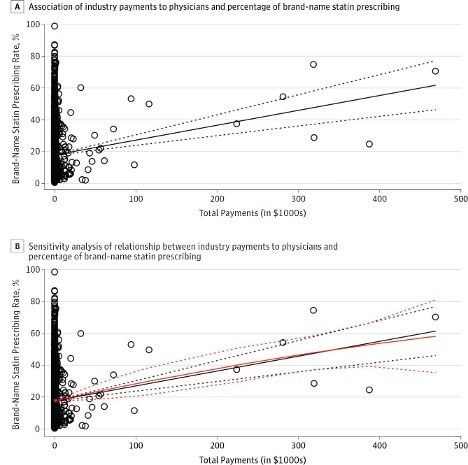
The ACC/AHA guidelines themselves disclose extensive author relationships with pharmaceutical companies that manufacture lipid-lowering drugs. Yeh et al. demonstrated in JAMA Internal Medicine that industry payments to physicians are associated with increased prescribing of brand-name statins.
Figure 1. Effect of Industry Payments on Brand-name Statin Prescribing
Association of Industry Payments to Physicians With the Prescribing of Brand-name Statins in Massachusetts. JAMA Intern Med. May 31, 2016.
Jefferson and Pearson's analysis in JAMA Internal Medicine found that among the 2013 ACC/AHA cholesterol guideline committee of 16 members, 7 (44%) disclosed one or more types of commercial conflict of interest, including industry-sponsored research grants, and 6 (38%) were also consultants.[18] The committee chair disclosed no commercial COI during the guideline period, but in contemporaneous published articles disclosed service as a consultant and honoraria for educational activities from manufacturers of cholesterol treatments. He had ended relationships with 6 companies that made drugs to treat hyperlipidemia just one year before the committee's first meeting.[18]
Yeh et al. demonstrated in JAMA Internal Medicine that industry payments to physicians were directly associated with increased brand-name statin prescribing — for every $1,000 in total payments received, the brand-name statin prescribing rate increased by 0.1% (P .001). Payments for educational training were associated with a 4.8% increase in brand-name prescribing (P = .004).[19]
---
5. Why the Harvard Article May Have Been Removed
The Harvard Health article accurately stated basic physiology — that cholesterol is essential, that the body manufactures it, and that it serves critical functions in the brain.[1][2][3] This is not controversial science; it is textbook biochemistry. The removal in 2019 coincides with a period of intensified "lower is better" messaging and the expansion of PCSK9 inhibitor marketing. While the specific reason for removal cannot be confirmed, the article's content — emphasizing cholesterol's essential nature — runs counter to the simplified public health messaging that cholesterol is inherently harmful and must be lowered.
---
6. The Statin-to-Biologic Transition: Follow the Patents
Follow-up Question: "Can you explain why, in 2011, Harvard, through their 'proto' magazine, published an article titled 'questioning statins?' I will answer the question for you. Because Harvard was preparing for the transition from off-patent statins to the new, expensive, on-patent biologics like Repatha."
The financial timeline aligns precisely:
Key patent expirations for blockbuster statins:
- Pravastatin (Pravachol): generic 2006
- Simvastatin (Zocor): generic 2006
- Atorvastatin (Lipitor): generic November 2011 — the single best-selling drug in pharmaceutical history (~$125 billion in cumulative sales)
- Rosuvastatin (Crestor): generic 2016
Harvard's Proto article appeared in 2011 — the same year Lipitor lost patent protection. Meanwhile, PCSK9 inhibitor development was accelerating: evolocumab (Repatha) was approved in 2015 and alirocumab (Praluent) in 2015, with list prices exceeding $14,500 per year — more than 100× the cost of generic statins.[20][21]
The narrative shift followed a recognizable pattern:
1. While statins were on-patent: The messaging was "statins are safe, effective, and everyone at risk should be on one." Guideline targets were progressively lowered, expanding the treatable population.
2. As statins went generic (~2006–2016): Articles questioning statin efficacy and safety began appearing in mainstream outlets, including from academic institutions. The narrative shifted to "statins may not be enough" and "residual risk remains."
3. When PCSK9 inhibitors arrived (2015): The messaging became "statins plus PCSK9 inhibitors" — and guidelines were updated to include these expensive biologics for patients who "fail to reach target" on statins alone.[22][23]
The cost comparison:
- Generic statins: ~$4–$15/month
- PCSK9 inhibitors: ~$1,200/month ($14,500/year at launch; reduced to ~$5,850/year by 2023)[21][23]
- Inclisiran (Leqvio, approved 2021): similar pricing
- Bempedoic acid (Nexletol): another on-patent option
Hlatky and Kazi documented in JACC that PCSK9 inhibitors have incremental cost-effectiveness ratios of $141,700 to $450,000 per QALY — none meeting "good value" benchmarks. To be cost-effective by conventional standards, the cost would need to be reduced 70–85%.[21][24] The 2018 ACC/AHA Guidelines acknowledged that "all models project higher lifetime cost from use of PCSK9 inhibitors because the cost will exceed any savings from prevention of cardiovascular events".[24]
---
7. PCSK9 Inhibitors and All-Cause Mortality
Follow-up Question: "Show me if any biologic for reducing LDL shows a long-term reduction in all-cause mortality. Keep in mind the real answer is no because LDL is so important in the process of repairing tissue."
No PCSK9 inhibitor trial has demonstrated a statistically significant reduction in all-cause mortality in its primary analysis:
- FOURIER (evolocumab, n=27,564, median 2.2 years): All-cause mortality OR 1.04 (95% CI 0.91–1.19) — numerically higher, not lower. A reanalysis based on regulatory data found that cardiac deaths were numerically higher in the evolocumab group (113 vs. 88; RR 1.28, 95% CI 0.97–1.69), suggesting possible cardiac harm.[25][26]
- ODYSSEY OUTCOMES (alirocumab, n=18,924, median 2.8 years): All-cause mortality OR 0.83 (95% CI 0.72–0.96) — nominally significant but did not meet the prespecified hierarchical testing threshold.[25]
- Cochrane meta-analysis (24 studies, n=60,997): Evolocumab vs. placebo showed no mortality benefit; alirocumab vs. placebo showed a modest benefit that was not confirmed in active-comparator analyses.[25]
---
8. Why Most Clinicians Do Not Understand Lipoprotein Physiology
Medical education has historically taught "cholesterol" as a risk factor to be lowered, not as a family of essential amphipathic transport particles performing vital physiological functions. The distinction between the cholesterol molecule, cholesterol content within lipoproteins, lipoprotein particle number, and lipoprotein modification (oxidation, homocysteinylation) is rarely taught with the nuance it deserves. As the NEJM review by Michos et al. acknowledged, management of serum cholesterol has become "a central objective in the effort to prevent cardiovascular events" — yet the review itself focuses entirely on LDL-C lowering without discussing the essential physiological roles of the transport particles being targeted.[27]
The dietary cholesterol story is equally instructive. McNamara's review states that the original dietary cholesterol restrictions from the 1960s were "a rational conclusion based on the available science at that time" but that "fifty years later the research evidence no longer supports this hypothesis, yet changing the dietary recommendation has been a slow and at times contentious process" — a phenomenon he attributes to cognitive dissonance.[28]
---
9. The Total Cholesterol Equation Problem
Follow-up Comment from a later discussion: "If HDL is the 'good' cholesterol, and in patient 1, the good cholesterol is nice and high, why does it make the total cholesterol score worse? As your 'good' HDL cholesterol increases, your total cholesterol score worsens, and you are much more likely to be put on a statin drug."
The total cholesterol equation (TC = LDL-C + HDL-C + VLDL-C) is additive by definition — it sums all cholesterol fractions regardless of their biological roles. This means that increasing HDL-C (the "good" cholesterol) mathematically increases TC, potentially pushing a patient above a threshold that triggers statin prescribing. The 2026 ACC/AHA Guidelines now explicitly state that TC alone should not be used for treatment decisions and recommend apoB as a more accurate marker.[13] However, TC remains on standard lab panels and is still used by the vast majority of clinicians as a trigger for statin prescribing.
---
10. Summary of Key Conclusions
- Lipoproteins (LDL, HDL, VLDL) are essential amphipathic transport particles — structurally analogous to soap/detergent molecules — that solubilize and transport hydrophobic fats through the aqueous bloodstream. They also serve innate immune functions, neutralizing bacterial endotoxins and modulating TLR responses.[4][5][6][7][8][9][10]
- Cholesterol is essential for life: it is a structural component of every cell membrane, a precursor for steroid hormones, vitamin D, and bile acids, and constitutes ~25% of brain lipid content.[1][2][3]
- The liver manufactures the majority of circulating cholesterol because it is too important to rely on dietary intake.[1]
- LDL-C is not a measurement of cholesterol — it is an estimate of cholesterol mass within a heterogeneous population of LDL particles that vary widely in their actual cholesterol content.[11][12]
- The demonization of these essential molecules occurred through a convergence of: (1) oversimplified early science extrapolated from herbivore models; (2) the diet-heart hypothesis introduced in the 1950s based on weak associational evidence; (3) institutional momentum once guidelines were established; (4) pharmaceutical industry incentives that benefit from expanding the treatable population; (5) medical education that teaches "cholesterol = bad" without teaching lipoprotein biochemistry; and (6) the conflation of the cholesterol molecule with LDL-C.[16][17][18][19][21]
- The Harvard article stated basic, undisputed physiology. Its removal is consistent with a broader pattern in which accurate but inconvenient physiological facts are subordinated to simplified public health messaging.
- The transition from generic statins to expensive on-patent biologics (PCSK9 inhibitors, inclisiran) followed a documented pattern: undermine the generic, promote the patent — supported by guideline committees with documented industry conflicts of interest.[18][21]
- No PCSK9 inhibitor has demonstrated a statistically significant reduction in all-cause mortality in its primary analysis.[25][26]
- The dietary cholesterol restrictions that shaped decades of public health policy were based on evidence that "no longer supports this hypothesis," yet changing the recommendation has been impeded by cognitive dissonance.[28]
References
1. Central Nervous System Cholesterol Metabolism in Health and Disease. Ho WY, Hartmann H, Ling SC. IUBMB Life. 2022;74(8):826-841. doi:10.1002/iub.2662.
2. Cholesterol in Brain Disease: Sometimes Determinant and Frequently Implicated. Martín MG, Pfrieger F, Dotti CG. EMBO Reports. 2014;15(10):1036-52. doi:10.15252/embr.201439225.
3. Cholesterol Homeostasis: Researching a Dialogue Between the Brain and Peripheral Tissues. Gliozzi M, Musolino V, Bosco F, et al. Pharmacological Research. 2021;163:105215. doi:10.1016/j.phrs.2020.105215.
4. Triglycerides and Cardiovascular Disease: A Scientific Statement From the American Heart Association. Miller M, Stone NJ, Ballantyne C, et al. Circulation. 2011;123(20):2292-333. doi:10.1161/CIR.0b013e3182160726.
5. Obesity, Dyslipidemia, and Cardiovascular Disease: A Joint Expert Review From the Obesity Medicine Association and the National Lipid Association 2024. Bays HE, Kirkpatrick CF, Maki KC, et al. Journal of Clinical Lipidology. 2024 May-Jun;18(3):e320-e350. doi:10.1016/j.jacl.2024.04.001.
6. Lipoprotein Physiology. Ginsberg HN. Endocrinology and Metabolism Clinics of North America. 1998;27(3):503-19. doi:10.1016/s0889-8529(05)70023-2.
7. Co‐opting biology to deliver drugs. Yousefpour P, Chilkoti A. Biotechnology and Bioengineering. 2014;111(9):1699-716. doi:10.1002/bit.25307.
8. Plasma Lipoproteins Are Important Components of the Immune System. Han R. Microbiology and Immunology. 2010;54(4):246-53. doi:10.1111/j.1348-0421.2010.00203.x.
9. LPS-binding Protein Circulates in Association With apoB-containing Lipoproteins and Enhances Endotoxin-LDL/VLDL Interaction. Vreugdenhil AC, Snoek AM, van 't Veer C, Greve JW, Buurman WA. The Journal of Clinical Investigation. 2001;107(2):225-34. doi:10.1172/JCI10832.
10. Lipoproteins Attenuate TLR2 and TLR4 Activation by Bacteria and Bacterial Ligands With Differences in Affinity and Kinetics. van Bergenhenegouwen J, Kraneveld AD, Rutten L, et al. BMC Immunology. 2016;17(1):42. doi:10.1186/s12865-016-0180-x.
11. Beyond Low-Density Lipoprotein Cholesterol: Defining the Role of Low-Density Lipoprotein Heterogeneity in Coronary Artery Disease. Mudd JO, Borlaug BA, Johnston PV, et al. Journal of the American College of Cardiology. 2007;50(18):1735-41. doi:10.1016/j.jacc.2007.07.045.
12. Discordance Between Lipoprotein Particle Number and Cholesterol Content: An Update. Cantey EP, Wilkins JT. Current Opinion in Endocrinology, Diabetes, and Obesity. 2018;25(2):130-136. doi:10.1097/MED.0000000000000389.
13. 2026 ACC/AHA/AACVPR/ABC/ACPM/ADA/AGS/APhA/ASPC/NLA/PCNA Guideline on the Management of Dyslipidemia: A Report of the American College of Cardiology/American Heart Association Joint Committee on Clinical Practice Guidelines. Blumenthal RS, Morris PB, Gaudino M, et al. Journal of the American College of Cardiology. 2026;:S0735-1097(25)10254-4. doi:10.1016/j.jacc.2025.11.016.
14. Reduction in Saturated Fat Intake for Cardiovascular Disease. Hooper L, Martin N, Jimoh OF, et al. The Cochrane Database of Systematic Reviews. 2020;8:CD011737. doi:10.1002/14651858.CD011737.pub3.
15. Saturated Fats and Health: A Reassessment and Proposal for Food-Based Recommendations: JACC State-of-the-Art Review. Astrup A, Magkos F, Bier DM, et al. Journal of the American College of Cardiology. 2020;76(7):844-857. doi:10.1016/j.jacc.2020.05.077.
16. A Short History of Saturated Fat: The Making and Unmaking of a Scientific Consensus. Teicholz N. Current Opinion in Endocrinology, Diabetes, and Obesity. 2023;30(1):65-71. doi:10.1097/MED.0000000000000791.
17. Re-Evaluation of the Traditional Diet-Heart Hypothesis: Analysis of Recovered Data From Minnesota Coronary Experiment (1968-73). Ramsden CE, Zamora D, Majchrzak-Hong S, et al. BMJ (Clinical Research Ed.). 2016;353:i1246. doi:10.1136/bmj.i1246.
18. Conflict of Interest in Seminal Hepatitis C Virus and Cholesterol Management Guidelines. Jefferson AA, Pearson SD. JAMA Internal Medicine. 2017;177(3):352-357. doi:10.1001/jamainternmed.2016.8439.
19. Association of Industry Payments to Physicians With the Prescribing of Brand-name Statins in Massachusetts. Yeh JS, Franklin JM, Avorn J, Landon J, Kesselheim AS. JAMA Internal Medicine. 2016;176(6):763-8. doi:10.1001/jamainternmed.2016.1709.
20. FDA Orange Book. FDA Orange Book.
21. PCSK9 Inhibitors: Economics and Policy. Hlatky MA, Kazi DS. Journal of the American College of Cardiology. 2017;70(21):2677-2687. doi:10.1016/j.jacc.2017.10.001.
22. 2022 ACC Expert Consensus Decision Pathway on the Role of Nonstatin Therapies for LDL-Cholesterol Lowering in the Management of Atherosclerotic Cardiovascular Disease Risk: A Report of the American College of Cardiology Solution Set Oversight Committee. Writing Committee, Lloyd-Jones DM, Morris PB, et al. Journal of the American College of Cardiology. 2022;80(14):1366-1418. doi:10.1016/j.jacc.2022.07.006.
23. 2023 AHA/ACC/ACCP/ASPC/NLA/PCNA Guideline for the Management of Patients With Chronic Coronary Disease: A Report of the American Heart Association/American College of Cardiology Joint Committee on Clinical Practice Guidelines. Virani SS, Newby LK, Arnold SV, et al. Journal of the American College of Cardiology. 2023;82(9):833-955. doi:10.1016/j.jacc.2023.04.003.
24. 2018 AHA/ACC/AACVPR/AAPA/ABC/ACPM/ADA/AGS/APhA/ASPC/NLA/PCNA Guideline on the Management of Blood Cholesterol: Executive Summary: A Report of the American College of Cardiology/American Heart Association Task Force on Clinical Practice Guidelines. Grundy SM, Stone NJ, Bailey AL, et al. Journal of the American College of Cardiology. 2019;73(24):3168-3209. doi:10.1016/j.jacc.2018.11.002.
25. PCSK9 Monoclonal Antibodies for the Primary and Secondary Prevention of Cardiovascular Disease. Schmidt AF, Carter JL, Pearce LS, et al. The Cochrane Database of Systematic Reviews. 2020;10:CD011748. doi:10.1002/14651858.CD011748.pub3.
26. Restoring Mortality Data in the FOURIER Cardiovascular Outcomes Trial of Evolocumab in Patients With Cardiovascular Disease: A Reanalysis Based on Regulatory Data. Erviti J, Wright J, Bassett K, et al. BMJ Open. 2022;12(12):e060172. doi:10.1136/bmjopen-2021-060172.
27. Lipid Management for the Prevention of Atherosclerotic Cardiovascular Disease. Michos ED, McEvoy JW, Blumenthal RS. The New England Journal of Medicine. 2019;381(16):1557-1567. doi:10.1056/NEJMra1806939.
28. Dietary Cholesterol, Heart Disease Risk and Cognitive Dissonance. McNamara DJ. The Proceedings of the Nutrition Society. 2014;73(2):161-6. doi:10.1017/S0029665113003844.
Updates
Get low- and no-cost health tips and root-cause solutions.
FrugalDoc
Affordable Health & Wellness
© 2025 FrugalDoc Health & Wellness. All rights reserved.