
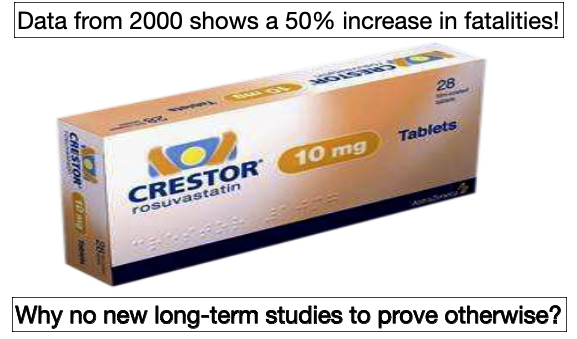
Crestor increases your risk of dying young - and studies have limited time frames.
The Crestor (statin) information presented to the FDA shows a 50% increase in fatalities in an old, small study, yet no new and longer-term studies have been conducted. What are "they" afraid of?
FrugalDoc
6/11/202610 min read
Crestor (Rosuvastatin): A Combined Critical Analysis of All-Cause Mortality and Fatal vs. Nonfatal Cardiovascular Events from the FDA Package Insert and Clinical Trials
Original Question 1: "Can you review the package insert for Crestor and any other data submitted to the FDA and provide a summary of early all-cause mortality data? Please provide a final document that can be downloaded and include the original question, figures, tables, and references."
Original Question 2: "In the Crestor package insert is the following information: Rosuvastatin significantly reduced the risk of myocardial infarction (6 fatal events and 62 nonfatal events in placebo-treated subjects vs. 9 fatal events and 22 nonfatal events in rosuvastatin-treated subjects) and the risk of stroke (6 fatal events and 58 nonfatal events in placebo-treated subjects vs. 3 fatal events and 30 nonfatal events in rosuvastatin-treated subjects). This information seems to imply there is possibly a significant increase in fatalities. Please comment."
---
Conclusion: The fatal MI numbers are particularly troubling: 9 fatal MIs in the rosuvastatin group vs. 6 in the placebo group — a 50% numerical increase.
---
PART I: OVERVIEW OF THE CRESTOR FDA PACKAGE INSERT
The Crestor (rosuvastatin) FDA label lists the following approved indications: reduction of risk of major adverse cardiovascular events (CV death, nonfatal MI, nonfatal stroke, or arterial revascularization) in adults at increased CV risk; adjunct to diet and exercise for LDL-C reduction in adults with hypercholesterolemia; slowing atherosclerosis progression; and treatment of familial hypercholesterolemia, primary dysbetalipoproteinemia, and hypertriglyceridemia.[1]
Notably, the FDA-approved indication is for "major adverse cardiovascular events" — a composite endpoint — not for reduction of all-cause mortality. The package insert does not claim a mortality benefit. THE FDA LITERALLY IGNORED THE FATALITY DATA - WHY?
---
PART II: THE FIVE MAJOR ROSUVASTATIN PLACEBO-CONTROLLED TRIALS — ALL-CAUSE MORTALITY
Five large randomized, double-blind, placebo-controlled trials form the core evidence base for rosuvastatin:
Trial Year N Population Dose Median Follow-up Primary Endpoint Met? All-Cause Mortality Result References
JUPITER 2008 17,802 Primary prevention; hsCRP ≥2 mg/L, LDL-C 130 mg/dL 20 mg 1.9 years Yes (44% RRR composite) HR 0.80 (0.67–0.97), p=0.02 — nominally significant [1][2]
CORONA 2007 5,011 Ischemic HFrEF, age ≥60 10 mg 2.7 years No No significant reduction (p=0.31) [3][4]
GISSI-HF 2008 4,574 Chronic HF (ischemic + non-ischemic) 10 mg 3.9 years No 657 deaths rosuvastatin vs. 644 placebo — no benefit (HR 1.00) [5]
AURORA 2009 2,555 Hemodialysis patients 10 mg 3.9 years No No significant reduction [6]
HOPE-3 2016 12,705 Intermediate-risk, no CVD 10 mg 5.6 years Yes (24% RRR composite) 334 vs. 357 deaths — not significant (5.3% vs. 5.6%) [7]
Trial-by-Trial Analysis
JUPITER enrolled 17,802 apparently healthy men ≥50 and women ≥60 years of age with LDL-C 130 mg/dL and hsCRP ≥2.0 mg/L. The trial was stopped early by the Data Safety Monitoring Board after a median follow-up of only 1.9 years. All-cause mortality rates were 1.00 vs. 1.25 per 100 person-years (HR 0.80, 95% CI 0.67–0.97, p=0.02).[1][2]
However, this finding has been subject to substantial published criticism:
- A critical reappraisal in JAMA Internal Medicine by de Lorgeril et al. (2010) concluded the trial was "flawed" — stopped after fewer than 2 years with "no differences between the 2 groups on the most objective criteria." The authors noted that "a close examination of the all-cause mortality curves shows that the curves were actually converging when the trial was ended."[8]
- Morrissey et al. (2011) in Current Atherosclerosis Reports noted that "by stopping the trial early, one cannot rule out the possibility that the treatment benefit was overestimated and risk was underestimated."
- Nine of 14 authors of the JUPITER article had financial ties to AstraZeneca (the sponsor). The principal investigator (Paul Ridker) was a co-holder of the patent for the hsCRP test used to select patients. The sponsor "collected the trial data and monitored the study sites."[8]
- In a subsequent Lancet analysis, among participants with no major diabetes risk factor, rosuvastatin yielded a 22% reduction in total mortality (HR 0.78, 95% CI 0.59–1.03, p=0.08) — not statistically significant.[9]
CORONA randomized 5,011 patients aged ≥60 with ischemic HFrEF to rosuvastatin 10 mg vs. placebo. Despite significant reductions in LDL-C and CRP, rosuvastatin did not reduce the primary composite endpoint (HR 0.92, 95% CI 0.83–1.02, p=0.12), and there was no significant reduction in all-cause mortality (p=0.31), coronary events, or worsening HF.[3][4][10]
GISSI-HF randomized 4,574 patients with chronic HF to rosuvastatin 10 mg vs. placebo. There were 657 deaths (29%) in the rosuvastatin group vs. 644 deaths (28%) in the placebo group — numerically more deaths with rosuvastatin (adjusted HR 1.00, 95.5% CI 0.898–1.122, p=0.943). There were no significant differences in sudden cardiac death, MI, stroke, or any cause of death.[5]
The GISSI-HF investigators concluded that their findings "clearly suggest that rosuvastatin has no beneficial effect in patients with chronic heart failure who were not already receiving statins, irrespective of the cause of the disorder."[5]
AURORA randomized 2,555 hemodialysis patients to rosuvastatin 10 mg vs. placebo over 3.9 years. There was no significant reduction in the primary composite endpoint or in all-cause mortality.[6]
HOPE-3 randomized 12,705 intermediate-risk participants without CVD to rosuvastatin 10 mg vs. placebo over 5.6 years. The primary composite endpoint was significantly reduced (HR 0.76, 95% CI 0.64–0.91, p=0.002). However, there was no significant difference in all-cause mortality: 334 deaths (5.3%) vs. 357 deaths (5.6%). CV death was also not significant: 154 (2.4%) vs. 171 (2.7%).[7]
---
PART III: FATAL VS. NONFATAL EVENTS — THE HIDDEN DATA IN THE CRESTOR PACKAGE INSERT
The Crestor package insert provides the following breakdown of MI and stroke events from the JUPITER trial:[1]
Event Type Placebo Rosuvastatin Direction References
Fatal MI 6 <strong>9</strong> 50% more fatal MIs with rosuvastatin [1]
Nonfatal MI 62 22 65% fewer nonfatal MIs with rosuvastatin [1]
Fatal stroke 6 3 50% fewer fatal strokes with rosuvastatin [1]
Nonfatal stroke 58 30 48% fewer nonfatal strokes with rosuvastatin [1]
<strong>Total fatal CV events (MI + stroke)</strong> <strong>12</strong> <strong>12</strong> <strong>Identical</strong> [1][2]
This is precisely the anomaly that de Lorgeril et al. identified. They calculated from the published JUPITER data that "cardiovascular mortality (fatal stroke plus fatal myocardial infarction) would therefore be identical in both groups (12 vs 12). Such a lack of effect on cardiovascular mortality associated with a strong effect on nonfatal complications strongly suggests a bias in the data set and should have led to the continuation of the trial rather than to its premature ending."[8]
The Fatal MI Signal
The fatal MI numbers are particularly troubling: 9 fatal MIs in the rosuvastatin group vs. 6 in the placebo group — a 50% numerical increase. The ratio of fatal to nonfatal MI was "incredibly low, especially in the placebo group" — only 6 fatal MIs out of 68 total MIs (8.8%), when the expected case-fatality rate for MI in such a population would be approximately 50%.[8]
Additional Inconsistencies
De Lorgeril et al. raised several additional red flags:[8]
- Cardiovascular mortality as a proportion of total mortality was only 5–18%, whereas the expected rate in a non-Japanese, non-Mediterranean population would be approximately 40%.
- No sudden cardiac deaths were reported in the entire JUPITER trial — despite SCD typically representing 65–70% of total cardiac mortality.
- When Ridker and Glynn responded that the calculations "do not account for deaths from vascular causes, such as aneurysm rupture," de Lorgeril pointed out the implausibility: "Would this mean that in the same period of time there were 6 fatal infarctions and 25 fatal aneurysm ruptures in the placebo group? This is highly unlikely."
- Even using Ridker's own numbers (35 confirmed CV deaths in rosuvastatin vs. 43 in placebo), the difference was not statistically significant.[8]
---
PART IV: THE BROADER CONTEXT — STATINS AND FATAL EVENTS IN PRIMARY PREVENTION
The 2022 USPSTF systematic review, pooling primary prevention trials, found:[11]
Endpoint Trials Pooled RR (95% CI) Statistically Significant? References
All-cause mortality 18 trials (n=85,186) 0.92 (0.87–0.98) Yes (borderline; NNT = 286) [1]
Cardiovascular mortality 12 trials (n=75,138) 0.91 (0.81–1.02) <strong>No</strong> [1]
Fatal MI 6 trials (n=38,083) 0.83 (0.51–1.37) <strong>No</strong> [1]
Fatal stroke 3 trials (n=29,520) 0.73 (0.35–1.50) <strong>No</strong> [1]
Notably, the 2022 USPSTF review found that the pooled all-cause mortality estimate was "slightly attenuated" compared with the 2016 review (which had shown RR 0.86, 95% CI 0.80–0.97), suggesting that as more data accumulated, the mortality benefit became less robust.[11]
---
PART V: SUMMARY OF ALL-CAUSE MORTALITY ACROSS ALL ROSUVASTATIN TRIALS
Trial Rosuvastatin Deaths Placebo Deaths HR (95% CI) p-value Significant? References
JUPITER ~198<em> ~247</em> 0.80 (0.67–0.97) 0.02 Yes (borderline) — but trial stopped early [1]
CORONA NS NS NS (p=0.31) 0.31 No [2][3]
GISSI-HF 657 (29%) 644 (28%) 1.00 (0.898–1.122) 0.943 No — numerically more deaths with rosuvastatin [4]
AURORA NS NS NS NS No [5]
HOPE-3 334 (5.3%) 357 (5.6%) NS NS No [6]
Approximate death counts from JUPITER based on published rates (1.00 vs. 1.25 per 100 person-years over median 1.9 years in ~8,900 per group).
---
PART VI: FINAL CONCLUSIONS
Conclusion 1: Rosuvastatin has not demonstrated a reliable all-cause mortality benefit.
Across five major placebo-controlled trials enrolling over 43,000 patients, only one trial (JUPITER) demonstrated a statistically significant all-cause mortality reduction — and that trial was stopped early after only 1.9 years of median follow-up, had extensive industry conflicts of interest (9 of 14 authors with financial ties to AstraZeneca, principal investigator co-holding the hsCRP patent), and has been the subject of a published critical reappraisal in JAMA Internal Medicine concluding that "the results of the trial do not support the use of statin treatment for primary prevention of cardiovascular diseases and raise troubling questions concerning the role of commercial sponsors."[8]
The four other rosuvastatin trials — representing over 25,000 patients followed for 2.7 to 5.6 years — uniformly failed to demonstrate an all-cause mortality benefit. GISSI-HF showed numerically more deaths with rosuvastatin (657 vs. 644). HOPE-3, the longest trial at 5.6 years, showed no mortality benefit despite enrolling over 12,000 participants.[5][7]
Conclusion 2: Rosuvastatin's "significant reduction in MI and stroke" was driven entirely by nonfatal events.
The Crestor package insert's own data reveal that the total number of fatal cardiovascular events (MI + stroke) was identical in both groups: 12 vs. 12. Fatal MI was numerically higher with rosuvastatin (9 vs. 6). The "significant" reductions were in nonfatal MI and nonfatal stroke — endpoints that are more subjective, more susceptible to ascertainment bias, and more influenced by physician decision-making (e.g., whether to diagnose a troponin elevation as MI).[1][8]
Conclusion 3: The fatal event data are epidemiologically inconsistent.
The case-fatality rate for MI in the placebo group (8.8%) was far below the expected ~50%. No sudden cardiac deaths were reported despite SCD typically representing 65–70% of cardiac mortality. Cardiovascular mortality as a proportion of total mortality was only 5–18% vs. an expected ~40%. These inconsistencies, identified by de Lorgeril et al., have never been adequately explained in any JUPITER publication.[8]
Conclusion 4: The broader statin literature confirms no significant reduction in fatal cardiovascular events in primary prevention.
The 2022 USPSTF systematic review found that across all primary prevention statin trials, fatal MI (RR 0.83, 95% CI 0.51–1.37), fatal stroke (RR 0.73, 95% CI 0.35–1.50), and cardiovascular mortality (RR 0.91, 95% CI 0.81–1.02) were all not statistically significant. The all-cause mortality estimate has attenuated with each successive review as more data accumulate.[11]
Conclusion 5: The FDA does not endorse a mortality claim for Crestor.
The FDA-approved indication is limited to reduction of "major adverse cardiovascular events" — a composite endpoint that includes revascularization procedures and hospitalizations, which are medical decisions rather than hard clinical outcomes. The package insert also notes that in a post-hoc subgroup analysis of JUPITER subjects with hsCRP ≥2 mg/L and no other traditional risk factors other than age, "there was no significant treatment benefit with Crestor treatment."[1]
Conclusion 6: The heart failure trials provide the clearest evidence of futility.
Both CORONA and GISSI-HF showed no mortality benefit whatsoever despite rosuvastatin achieving "substantial and sustained biological effects" on LDL-C and CRP. A subsequent meta-analysis of CORONA, GISSI-HF, and PEARL demonstrated "no significant reduction in sudden cardiac death, total mortality, or hospitalization for HF." The GISSI-HF investigators concluded that the "so-called pleiotropic effects of statins" had received "probably overstated support from the published work."[3][5]
---
Overall Summary
The totality of rosuvastatin-specific evidence reveals a drug whose cardiovascular "benefits" are confined to nonfatal, softer endpoints — while the hardest, most objective endpoints (fatal MI, fatal stroke, cardiovascular death, all-cause mortality) show no consistent benefit across any trial except the prematurely terminated, commercially conflicted JUPITER trial. The package insert's own data, when examined at the level of fatal vs. nonfatal events, reveal that the drug did not reduce cardiovascular death and was associated with numerically more fatal MIs than placebo. These findings, combined with the epidemiological inconsistencies identified by de Lorgeril et al. and the attenuating mortality signal in successive USPSTF reviews, raise fundamental questions about whether rosuvastatin — and by extension, the strategy of pharmacologically lowering LDL-C — reduces the events that matter most: death.
References
1. Crestor. Food and Drug Administration. Updated date: 2026-04-29.
2. Rosuvastatin to Prevent Vascular Events in Men and Women with Elevated C-Reactive Protein. Ridker PM, Danielson E, Fonseca FA, et al. The New England Journal of Medicine. 2008;359(21):2195-207. doi:10.1056/NEJMoa0807646.
3. 2026 ACC/AHA/AACVPR/ABC/ACPM/ADA/AGS/APhA/ASPC/NLA/PCNA Guideline on the Management of Dyslipidemia: A Report of the American College of Cardiology/American Heart Association Joint Committee on Clinical Practice Guidelines. Blumenthal RS, Morris PB, Gaudino M, et al. Journal of the American College of Cardiology. 2026;:S0735-1097(25)10254-4. doi:10.1016/j.jacc.2025.11.016.
4. Contributory Risk and Management of Comorbidities of Hypertension, Obesity, Diabetes Mellitus, Hyperlipidemia, and Metabolic Syndrome in Chronic Heart Failure: A Scientific Statement From the American Heart Association. Bozkurt B, Aguilar D, Deswal A, et al. Circulation. 2016;134(23):e535-e578. doi:10.1161/CIR.0000000000000450.
5. Effect of Rosuvastatin in Patients With Chronic Heart Failure (The GISSI-HF Trial): A Randomised, Double-Blind, Placebo-Controlled Trial. Tavazzi L, Maggioni AP, Marchioli R, et al. Lancet (London, England). 2008;372(9645):1231-9. doi:10.1016/S0140-6736(08)61240-4.
6. Assessment of Adverse Effects Attributed to Statin Therapy in Product Labels: A Meta-Analysis of Double-Blind Randomised Controlled Trials. Cholesterol Treatment Trialists' (CTT) Collaboration. Electronic address: ctt@ndph.ox.ac.uk, Cholesterol Treatment Trialists' (CTT) Collaboration. Lancet (London, England). 2026;407(10529):689-703. doi:10.1016/S0140-6736(25)01578-8.
7. Cholesterol Lowering in Intermediate-Risk Persons without Cardiovascular Disease. Yusuf S, Bosch J, Dagenais G, et al. The New England Journal of Medicine. 2016;374(21):2021-31. doi:10.1056/NEJMoa1600176.
8. Cholesterol Lowering, Cardiovascular Diseases, and the Rosuvastatin-JUPITER Controversy: A Critical Reappraisal. de Lorgeril M, Salen P, Abramson J, et al. Archives of Internal Medicine. 2010;170(12):1032-6. doi:10.1001/archinternmed.2010.184.
9. Cardiovascular Benefits and Diabetes Risks of Statin Therapy in Primary Prevention: An Analysis From the JUPITER Trial. Ridker PM, Pradhan A, MacFadyen JG, Libby P, Glynn RJ. Lancet (London, England). 2012;380(9841):565-71. doi:10.1016/S0140-6736(12)61190-8.
10. Impact of Statin Therapy in Heart Failure Patients: Results of a Large Real-World Experience. Anderson JL, May HT, Le VT, et al. JACC. Advances. 2023;2(4):100385. doi:10.1016/j.jacadv.2023.100385.
11. Statin Use for the Primary Prevention of Cardiovascular Disease in Adults: Updated Evidence Report and Systematic Review for the US Preventive Services Task Force. Chou R, Cantor A, Dana T, et al. JAMA. 2022;328(8):754-771. doi:10.1001/jama.2022.12138.
Updates
Get low- and no-cost health tips and root-cause solutions.
FrugalDoc
Affordable Health & Wellness
© 2025 FrugalDoc Health & Wellness. All rights reserved.